

[Jun 22, 2026] WGU Organizational-Behavior Real Exam Questions and Answers FREE
Pass WGU Organizational-Behavior Exam Info and Free Practice Test
NEW QUESTION # 13
Management has noticed that the accounting work group is having difficulty because group members seem to be working in different directions. Which suggested action can the company take to increase group cohesiveness?
- A. Establish more rigid role definition for group members
- B. Have the group avoid competition with other groups
- C. Give individual rewards rather than group rewards
- D. Give group rewards rather than individual rewards
Answer: D
Explanation:
Group cohesiveness refers to the degree to which members are attracted to one another and are motivated to remain part of the group. When members are "working in different directions," it indicates a lack of alignment and shared purpose. One of the most effective structural methods to foster unity is togive group rewards rather than individual rewards. When rewards are tied to the collective output of the team, members are incentivized to collaborate, share information, and support one another to ensure the entire group succeeds.
Individual rewards often foster internal competition, which can further fragment a group that is already struggling with alignment.
In addition to group-based rewards, other strategies to increase cohesiveness include making the group smaller, increasing the time members spend together, and stimulating competition withothergroups (rather than avoiding it). By shifting the focus from individual achievement to collective success, the organization encourages members to coordinate their efforts, thereby increasing the "we-feeling" necessary for high- performing teams.
NEW QUESTION # 14
What defines acceptable standards of behavior that are shared by group members?
- A. Group norms
- B. Group roles
- C. Group conformity
- D. Group status
Answer: A
Explanation:
All groups have establishedNorms, which are defined as acceptable standards of behavior shared by the group's members that tell them what they ought and ought not to do under certain circumstances. Norms are powerful because they act as a means of influencing the behavior of group members with a minimum of external controls. Common organizational norms include performance norms (how hard to work), appearance norms (dress codes), and social arrangement norms (whom to eat lunch with).
Norms are distinct fromGroup Roles, which are specific behaviors expected of a person in a specific position.
While roles might differ from member to member (e.g., a leader vs. a scribe), norms are generally shared by the entire collective.Group Statusrefers to a socially defined position or rank given to groups or group members by others, andConformityis the act of adjusting one's behavior to align with the norms of the group.
Therefore, the "standards of behavior" themselves are the norms. When an individual violates these shared standards, they often face social pressure or sanctions from the group, which reinforces the importance of norms in maintaining group stability and predictability.
NEW QUESTION # 15
Which option defines organizational culture?
- A. A system of unique physical parameters that describes the organization
- B. A human resources department program for recognizing diversity
- C. A unique system of shared organizational meaning
- D. A method of stratifying the organization's target market
Answer: C
Explanation:
Organizational culture is defined as aunique system of shared meaningheld by members that distinguishes the organization from other organizations. This system of shared meaning is a set of key characteristics that the organization values. It represents the "common perception" held by the organization's members; even though individuals may have different backgrounds or occupy different levels in the hierarchy, they tend to describe the organization's culture in similar terms.
Culture is the social glue that helps hold the organization together by providing appropriate standards for what employees should say and do. It acts as a boundary-defining element, creates a sense of identity for employees, facilitates commitment to something larger than individual self-interest, and enhances the stability of the social system. While physical parameters (Option A) or HR programs (Option B) may reflect or support the culture, the culture itself is the underlying shared cognitive framework-the "way we do things around here"-that guides employee behavior and shapes their organizational experience.
NEW QUESTION # 16
A is ambitious and cheerful at work. Which type of values are these?
- A. Terminal values
- B. Instrumental values
- C. Determinate values
- D. Intermediate values
Answer: B
Explanation:
Values represent basic convictions that a specific mode of conduct or end-state of existence is personally or socially preferable to an opposite mode. In Organizational Behavior, Milton Rokeach created the Rokeach Value Survey (RVS), which classifies values into two distinct sets: Terminal values and Instrumental values.
Terminal valuesrefer to desirable end-states of existence. These are the goals a person would like to achieve during their lifetime, such as world peace, prosperity, or a sense of accomplishment.Instrumental values, on the other hand, refer to preferable modes of behavior or means of achieving the terminal values. Being
"ambitious" and "cheerful" are behavioral traits or methods that an individual employs to reach their ultimate goals. For instance, being ambitious (an instrumental value) is the "means" an employee uses to achieve the
"end" of financial success or career status (a terminal value). Similarly, being cheerful is a mode of conduct that might help an individual achieve the terminal goal of social recognition or happiness. Therefore, because these descriptions focus on thehowof behavior rather than thewhatof ultimate life goals, they are strictly categorized as instrumental values. Understanding these values is crucial for managers because they influence motivation and how employees perceive organizational rewards and culture.
NEW QUESTION # 17
What is a characteristic employed by transactional leaders?
- A. Instills pride and gains trust
- B. Provides vision and sense of mission
- C. Promotes intelligence and rationality
- D. Promises rewards for good performance
Answer: D
Explanation:
Organizational Behavior distinguishes between transformational andtransactional leaders. Transactional leaders guide or motivate their followers in the direction of established goals by clarifying role and task requirements. They function primarily through a series of "transactions" or exchanges where the leader provides something the followers want in return for their performance.
One of the primary characteristics of transactional leadership iscontingent reward, which involvespromising rewards for good performanceand recognizing accomplishments. Other characteristics include management by exception (active or passive), where the leader intervenes only when standards are not met. Options A, B, and C describe transformational leaders, who inspire followers to transcend their own self-interests for the good of the organization and are capable of having a profound and extraordinary effect on followers. While transformational leadership is often celebrated for driving innovation and change, transactional leadership remains essential for maintaining the day-to-day stability and efficiency of an organization by ensuring that employees are rewarded for meeting specific, tangible targets.
NEW QUESTION # 18
Although team performance has been fairly good, members feel that more could be done to improve their effectiveness. They feel that some team members could be more collaborative. Which type of reward system could be used effectively in this situation?
- A. A system that emphasizes rewards for individual contributions as well as for selfless contributions
- B. A system that emphasizes group rewards for maximizing productivity
- C. A system that emphasizes individual rewards for aggressive competitiveness
- D. A system that emphasizes group rewards based on aggressive competitiveness
Answer: A
Explanation:
Designing an effective reward system for teams requires a delicate balance between individual and collective incentives. If the reward system focuses solely on individual achievement, it can foster internal competition and discourage the very collaboration the team is lacking. Conversely, if it focuses only on the group, "social loafing" may occur where some members coast on the efforts of others.
To improve effectiveness and collaboration, the organization should implementa system that emphasizes rewards for individual contributions as well as for selfless contributions. This means that while members are recognized for their technical proficiency, they are also evaluated and rewarded for being "good team players"-sharing information, helping colleagues, and resolving conflicts. Rewarding "selfless contributions" directly addresses the concern that members need to be more collaborative. This dual-focus approach ensures that individuals are motivated to perform their specific tasks at a high level while simultaneously being incentivized to support the team's overall synergy.
NEW QUESTION # 19
Management has noticed that the quality improvement work group is struggling because members seem to be working in different directions. Which suggested action can the company take to increase group cohesiveness?
- A. Make the group larger
- B. Physically isolate the group
- C. Establish more rigid roles for group members
- D. Increase the difficulty of becoming a group member
Answer: B
Explanation:
Group Cohesivenessis the degree to which members are attracted to each other and motivated to stay in the group. When a group is "working in different directions," it lacks the unity and shared purpose characteristic of cohesive teams. To increase cohesiveness, Organizational Behavior literature suggests several specific strategies.
One effective method is toPhysically isolate the group. By providing the group with its own workspace or isolating them from other units, the members are forced to interact more frequently with one another rather than with outsiders. This increased interaction often leads to a stronger shared identity and a "we-feeling" that helps align their efforts. Other common ways to increase cohesiveness include making the group smaller (not larger, which refutes option C), increasing the time members spend together, and increasing the status of the group or the difficulty of gaining admission. While option A (increasing difficulty of membership) is a valid way to increase cohesiveness, the provided source materials and the context of members "working in different directions" prioritize physical isolation as a primary structural intervention to foster unity. Creating more rigid roles (Option D) might help with clarity but does not necessarily increase the emotional and social attraction (cohesion) between members.
NEW QUESTION # 20
Management is considering a change in one plant and plans to organize employees into teams. Management wants the teams to review processes, apply critical thinking, and take full responsibility for outcomes. Which type of team should they organize?
- A. Virtual teams
- B. Problem-solving teams
- C. Self-managed teams
- D. Production teams
Answer: C
Explanation:
The distinguishing factor between different types of teams is the level of authority and the scope of their responsibility.Problem-solving teamstypically only make recommendations; they do not have the authority to implement their suggestions or take full responsibility for the results.Virtual teamsare defined by their use of technology to bridge physical distance rather than their level of autonomy.
In this scenario, because management wants the team to "take full responsibility for outcomes," they must organizeself-managed teams. These teams are designed to operate without direct supervision, handling the planning, execution, and monitoring of their work. They go beyond critical thinking and process review- which a problem-solving team might do-by actually making the operating decisions and being held accountable for the final performance. This structure requires a high degree of trust from management and extensive training for employees, as the team essentially performs the roles previously held by first-line supervisors.
NEW QUESTION # 21
How can an organization transmit its culture to its employees?
- A. By studying employee gripes and complaints
- B. By creating and repeating ritualistic activities
- C. By influencing the balance of cultural backgrounds of employees
- D. By requiring employees to memorize the mission statement
Answer: B
Explanation:
Culture is transmitted to employees in several ways, most notably through stories, rituals, material symbols, and language.Ritualsare repetitive sequences of activities that express and reinforce the key values of the organization-what goals are most important, which people are important, and which are expendable. For example, a company might hold an annual awards ceremony that celebrates "risk-taking," thereby reinforcing a culture of innovation more effectively than a written document could.
These ritualistic activities serve as a physical manifestation of the organization's underlying values. While mission statements (Option A) provide a formal overview, they often fail to capture the "lived experience" of the culture. Similarly, while the selection process influences who enters the organization, the transmission of culture happens after hiring through consistent, repeated social practices. By engaging in these rituals, employees internalize the organization's norms and expectations, transforming them from "outsiders" to
"insiders" who understand the shared organizational meaning.
NEW QUESTION # 22
Which conflict-resolution techniques might a manager use to control the level of conflict that has become dysfunctional?
- A. Satisfying goals and smoothing
- B. Confrontation and smoothing
- C. Smoothing and confrontation
- D. Compromise and superordinate goals
Answer: D
Explanation:
Conflict within an organization can be functional (supporting goals) or dysfunctional (hindering performance). When conflict becomes dysfunctional, managers must use conflict-resolution techniques to bring it back to a manageable or productive level. Two such techniques areCompromiseandSuperordinate goals.
Compromiseinvolves each party giving up something of value to reach a solution where no one is a clear winner or loser. It is often used when goals are important but not worth the potential disruption of more assertive methods.Superordinate goalsinvolve creating a shared goal that cannot be attained without the cooperation of each of the conflicting parties. By focusing on a higher-level objective, the competing groups or individuals are forced to set aside their differences to achieve a common success. Other techniques include problem-solving (face-to-face meetings), smoothing (playing down differences), and avoidance. Choosing the right technique depends on the nature of the conflict and the desired long-term relationship between the parties. In many organizational settings, shifting the focus to superordinate goals is particularly effective because it aligns individual interests with organizational outcomes.
NEW QUESTION # 23
What is a purpose of employee evaluations?
- A. To measure the psychological symptoms of organizational dysfunctionality
- B. To serve as a screening device for hiring new employees
- C. To educate employees on the personalities of supervisors and help them adjust to management styles
- D. To assist management in making human resource decisions
Answer: D
Explanation:
Performance evaluations serve several vital functions within an organization's management system. The primary purpose isto assist management in making human resource decisions. These decisions include identifying who should receive promotions, who is eligible for salary increases, and who might need to be transferred or even terminated.
Beyond administrative decisions, evaluations provide essential feedback to employees about how the organization views their performance. This feedback acts as a basis for personal development and career planning. Furthermore, evaluations help identify training and development needs by pinpointing specific skill deficiencies that an employee may have. They also provide a criterion against which the organization can validate its selection and development programs; for instance, if employees who scored high on a hiring test perform poorly on their evaluations, the hiring process may need to be adjusted. Therefore, rather than being a psychological diagnostic tool (Option B) or a pre-hiring screen (Option C), the performance evaluation is a retrospective and developmental tool used to manage the existing workforce effectively.
NEW QUESTION # 24
What is an aspect of cross-functional teams that makes them difficult to manage?
- A. Team leaders cannot ensure that team members are located in the same work unit.
- B. Cross-functional leaders prevent team members from making their own decisions.
- C. It takes time to build trust and teamwork among people with different experiences and perspectives.
- D. Cross-functionality fluctuates too frequently.
Answer: C
Explanation:
Cross-functional teams are composed of employees from about the same hierarchical level but from different work areas-such as marketing, finance, and production-who come together to accomplish a task. While these teams are highly effective for coordinating complex projects and solving problems that require diverse perspectives, they are notoriously difficult to manage in the early stages.
The primary challenge is thatit takes time to build trust and teamworkamong people with different backgrounds, experiences, and perspectives. Each member comes from a different functional "culture" with its own jargon, priorities, and ways of looking at a problem. For example, a member from the engineering department might prioritize technical perfection, while a member from the marketing department might prioritize speed to market. These differing perspectives can lead to conflict and misunderstandings during the initial stages of group development. Furthermore, because members have primary loyalties to their home departments, creating a sense of "team identity" takes significant effort from the leader. Leaders of cross- functional teams must spend considerable time facilitating communication, resolving interpersonal conflicts, and aligning the various functional goals into a single project vision. Until a baseline of mutual trust is established, the team may struggle with "silo" thinking, where members protect their own department's interests rather than working toward the team's collective goal. Only after the team moves through the
"storming" phase of development and builds trust can it begin to leverage its diverse skills for high performance.
NEW QUESTION # 25
Which dimension of the Fiedler contingency model is associated with the degree of influence a leader has over variables such as hiring, firing, discipline, promotions, and salary increases?
- A. Position power
- B. Task structure
- C. Leader-member relations
- D. Leader-member exchange
Answer: A
Explanation:
The Fiedler contingency model proposes that effective group performance depends on the proper match between the leader's style and the degree to which the situation gives control to the leader. Fiedler identified three contingency dimensions that define the situational favorableness: Leader-member relations, Task structure, andPosition power.
Image of Fiedler's Contingency Model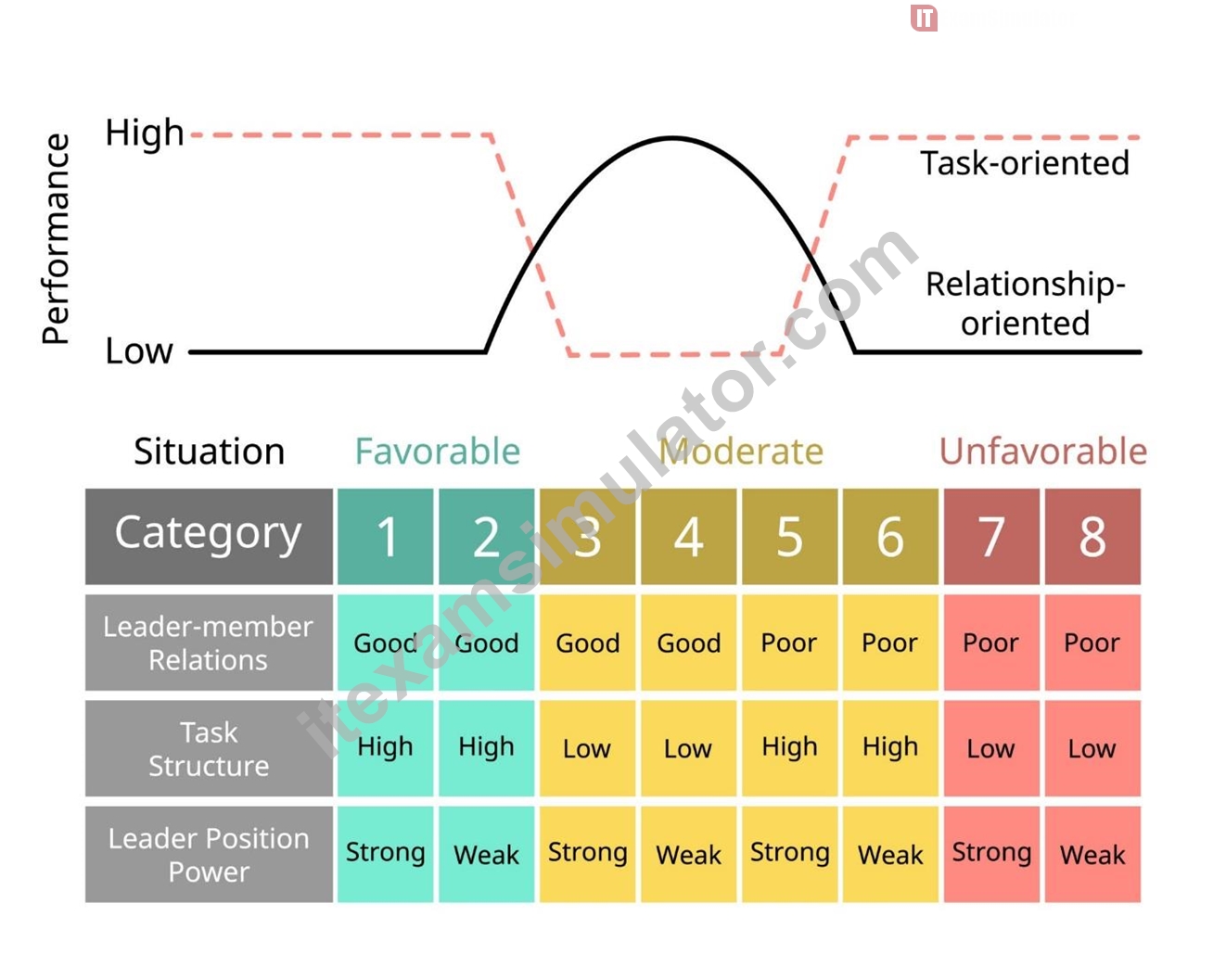
Position power is specifically defined as the degree of influence a leader has over power variables such as hiring, firing, discipline, promotions, and salary increases. A leader with high position power has significant structural authority, which makes it easier to influence the behavior of subordinates through formal rewards and sanctions. In contrast, a leader with low position power must rely more heavily on personal influence or rapport to achieve goals. Understanding these dimensions is crucial because Fiedler argued that a leader's style is essentially fixed; therefore, to improve effectiveness, one must either change the leader to fit the situation or change the situation (such as increasing or decreasing the leader's position power) to fit the leader.
NEW QUESTION # 26
What is true about the relationship between performance evaluation and motivation?
- A. The relationship does not depend on the perceptual process.
- B. The relationship is strongest when employees know that traits are the criteria used for the evaluations.
- C. The relationship is strong for employees but weak for managers.
- D. Employees must have confidence that the effort they exert will lead to a favorable performance evaluation.
Answer: D
Explanation:
The link between performance evaluation and motivation is best explained throughExpectancy Theory.
According to this theory, an individual's motivation to exert effort depends on three relationships: Effort- Performance, Performance-Reward, and Rewards-Personal Goals. For an employee to be motivated, they must have confidence that the effort they exert will lead to a favorable performance evaluation(the Effort-Performance relationship).
Image of Vroom's Expectancy Theory
If an employee believes that no matter how hard they work, the evaluation process is biased, based on luck, or uses unclear criteria (like personality traits rather than measurable behaviors), their motivation will suffer.
Furthermore, the employee must believe that a good evaluation will lead to organizational rewards (such as a bonus or promotion) and that those rewards will satisfy their personal goals. If any of these links are weak- for instance, if the evaluation process is perceived as unfair-the entire motivational chain is broken.
Therefore, the perceptual process is central to this relationship; it is not the objective reality of the evaluation that motivates, but the employee's perception of its fairness and accuracy.
NEW QUESTION # 27
What is an advantage of a strong organizational culture?
- A. There is ambiguity in what employees perceive as expectations.
- B. Core values are not intensely held and widely shared.
- C. The internal climate exhibits low behavioral control.
- D. There is a formation of strong employee commitment.
Answer: D
Explanation:
Astrong organizational cultureis one in which the core values are both intensely held and widely shared by the members. One of the primary advantages of such a culture is theformation of strong employee commitment. When employees believe in and identify with the organization's values, they are more likely to be dedicated to its goals and more willing to put in extra effort to see the organization succeed.
A strong culture also serves to reduce turnover because it creates a high level of agreement among members about what the organization stands for. This unanimity of purpose builds cohesiveness and loyalty.
Furthermore, a strong culture acts as a substitute for formalization; it tells employees how they are expected to behave without the need for thick manuals or rigid rules. While it can have liabilities (as noted in Q32), the immediate organizational benefit is a motivated, committed workforce that shares a common sense of direction.
NEW QUESTION # 28
A company switched from assembly lines to self-managed work teams. What can team members do to improve the synergy and success of their teams?
- A. Exercise collective control over the pace of work
- B. Assign individual roles rather than mutual team roles
- C. Share information but not engage in collective performance goals
- D. Change work group roles at random
Answer: A
Explanation:
A self-managed work team is characterized by its high level of autonomy and collective responsibility. To improve synergy and success, these teams must move beyond simply sharing information (which is characteristic of a work group) and engage in collective actions. One of the primary hallmarks of a successful self-managed team is the ability toexercise collective control over the pace of work.
In a traditional assembly line, the pace is dictated by the machinery or a supervisor. In a self-managed team, members decide how to schedule work, assign tasks, and monitor their own progress. This collective control fosters a sense of ownership and accountability. Options A and C describe traditional "work group" behaviors rather than team behaviors; teams require mutual accountability rather than just individual roles. By controlling their own pace and methods, team members can synchronize their efforts more effectively, leading to the positive synergy where the team's output is greater than the sum of individual inputs.
NEW QUESTION # 29
......
Latest Organizational-Behavior Exam Dumps WGU Exam: https://testking.itexamsimulator.com/Organizational-Behavior-brain-dumps.html
