

View All 300-740 Actual Free Exam Questions May 22, 2026 Updated
Pass Authentic Cisco 300-740 with Free Practice Tests and Exam Dumps
Cisco 300-740 Exam Syllabus Topics:
| Topic | Details |
|---|---|
| Topic 1 |
|
| Topic 2 |
|
| Topic 3 |
|
| Topic 4 |
|
| Topic 5 |
|
NEW QUESTION # 93 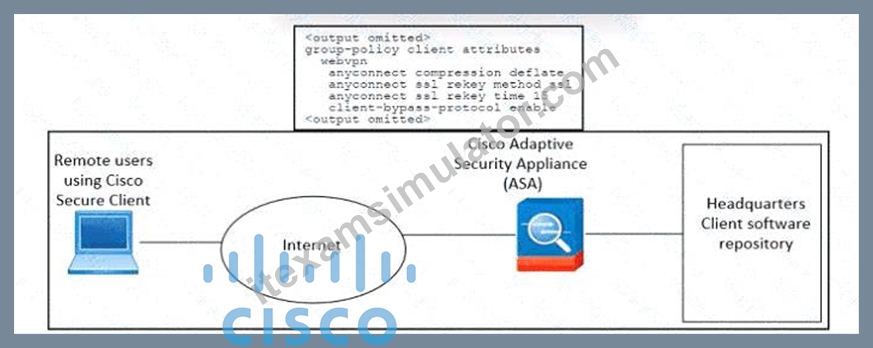
Refer to the exhibit. An engineer must configure Cisco ASA so that the Secure Client deployment is removed when the user laptop disconnects from the VPN. The indicated configuration was applied to the Cisco ASA firewall. Which command must be run to meet the requirement?
- A. anyconnect firewall-rule client-interface
- B. client-bypass-protocol enable
- C. anyconnect keep-installer none
- D. client-bypass-protocol disable
Answer: C
Explanation:
The anyconnect keep-installer none command is used to remove the Cisco Secure Client (formerly AnyConnect) from an endpoint once the VPN session ends. This is useful in temporary or kiosk-based access environments. The default behavior retains the client.
This capability is covered in SCAZT Section 2: User and Device Security (Pages 40-44), which outlines VPN session lifecycle management and Secure Client policies.
Reference: Designing and Implementing Secure Cloud Access for Users and Endpoints (SCAZT), Section 2, Pages 40-44
NEW QUESTION # 94
Cisco Secure Cloud Insights aids in cloud security by:
- A. Simplifying attack vectors for easier exploitation
- B. Offering visibility into cloud assets for improved governance and risk management
- C. Decreasing the granularity of cloud asset monitoring
- D. Focusing on non-cloud assets
Answer: B
NEW QUESTION # 95
Cisco Secure Firewall (FTD and ASA) is designed to:
- A. Only monitor outbound traffic for potential threats
- B. Simplify network design by removing the need for any other security measures
- C. Act solely as a physical barrier without any software-based controls
- D. Provide advanced threat defense and unified policy management
Answer: D
NEW QUESTION # 96
What helps prevent drive-by compromise?
- A. Ad blockers
- B. VPN
- C. Browsing known websites
- D. Incognito browsing
Answer: A
Explanation:
A drive-by compromise occurs when malicious code is automatically downloaded and executed simply by visiting a compromised website-often through malicious advertising scripts (malvertising). According to SCAZT Section 4: Application and Data Security (Pages 85-87), ad blockers help prevent drive-by downloads by blocking these third-party ad scripts and redirections, which are commonly used in such attacks.
VPNs and private browsing modes (e.g., Incognito) do not provide protection against malicious content hosted on web pages.
Reference: Designing and Implementing Secure Cloud Access for Users and Endpoints (SCAZT), Section 4, Pages 85-87
=========
NEW QUESTION # 97
SIEM tools provide which of the following benefits?
- A. Reduction in data analysis capabilities
- B. Real-time analysis of security alerts generated by applications and network hardware
- C. Decrease in operational efficiency
- D. Limited log storage
Answer: B
NEW QUESTION # 98 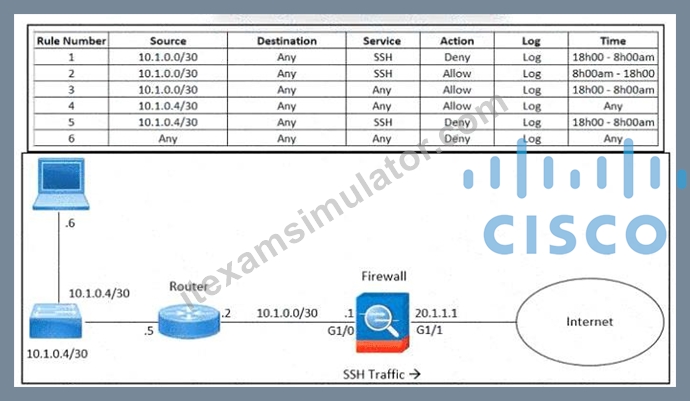
Refer to the exhibit. An engineer must troubleshoot an issue with excessive SSH traffic leaving the internal network between the hours of 18:00 and 08:00. The engineer applies a policy to the Cisco ASA firewall to block outbound SSH during the indicated hours; however, the issue persists. What should be done to meet the requirement?
- A. Change the time of rule 5
- B. Delete rule 3
- C. Change the time of rule 2.
- D. Delete rule 4
Answer: B
Explanation:
Rule 3 allows all traffic (including SSH) from 10.1.0.0/30 during the hours of 18:00-08:00, which directly conflicts with Rule 1 that is intended to deny SSH at those same hours. Since firewall rules are evaluated top- down and Rule 3 allows traffic during the exact period where SSH should be blocked, deleting Rule 3 will allow Rule 1 to apply correctly.
This behavior is explained in SCAZT Section 3 (Network and Cloud Security, Pages 72-75), where rule precedence and time-based evaluation logic are discussed.
Reference: Designing and Implementing Secure Cloud Access for Users and Endpoints (SCAZT), Section 3, Pages 72-75
NEW QUESTION # 99
Restoring affected systems after a security incident is known as _________.
- A. complicating
- B. abandoning
- C. quarantining
- D. reinstituting
Answer: D
NEW QUESTION # 100
The main benefit of integrating threat intelligence into cloud security is:
- A. Reducing the effectiveness of security operations
- B. Decreasing the need for secure domains
- C. Increasing the complexity of security architectures
- D. Enhancing the ability to identify and respond to emerging threats
Answer: D
NEW QUESTION # 101
What does the term "workload" refer to in the context of cloud security?
- A. The user's responsibility in managing cloud security
- B. The physical servers in a data center
- C. The amount of data processed by the cloud
- D. Applications and processes running in cloud environments
Answer: D
NEW QUESTION # 102
Which of the following are purposes of URL filtering in controlling access to cloud applications?
- A. To monitor employee productivity
- B. To increase internet speed
- C. To block access to unauthorized web content
- D. To prevent access to malicious websites
Answer: C,D
NEW QUESTION # 103
A web application firewall (WAF) protects against DDoS attacks by:
- A. Ignoring signs of an attack to maintain website functionality
- B. Physically disconnecting the server during an attack
- C. Analyzing and filtering incoming traffic to identify and block malicious requests
- D. Decreasing the security settings to allow all traffic
Answer: C
NEW QUESTION # 104
Cisco Secure Cloud Analytics helps in:
- A. Complicating compliance reporting
- B. Solely managing on-premises network traffic
- C. Decreasing visibility into cloud infrastructure
- D. Identifying potential security threats across cloud environments
Answer: D
NEW QUESTION # 105
A common identity across systems is essential for:
- A. Reducing network speed
- B. Increasing operational costs
- C. Isolating network segments
- D. Simplifying user access and security management
Answer: D
NEW QUESTION # 106
Which web application firewall deployment in the Cisco Secure DDoS protects against application layer and volumetric attacks?
- A. Hybrid
- B. On-demand
- C. Active/passive
- D. Always-on
Answer: D
Explanation:
According to the SCAZT guide, the "Always-on" deployment mode for Cisco Secure DDoS (including integration with Secure Web Application Firewall solutions) provides continuous protection for both volumetric and application-layer attacks. This deployment model ensures that all traffic flows through the scrubbing and WAF infrastructure without requiring traffic redirection only during attack events. It provides real-time mitigation and immediate detection, which is essential to address both volumetric attacks (e.g., SYN floods) and Layer 7 (application-layer) attacks such as HTTP floods and injection-based threats.
While "Hybrid" and "On-demand" modes are useful for specific use cases, only "Always-on" offers continuous and comprehensive protection required for environments that demand consistent uptime and threat prevention.
Reference: Designing and Implementing Secure Cloud Access for Users and Endpoints (SCAZT), Section 3:
Network and Cloud Security, Pages 68-71.
NEW QUESTION # 107
What role does OIDC play in web and mobile applications?
- A. It provides a mechanism for encrypting application data
- B. It specifies the physical security measures for devices
- C. It serves as a protocol for user authentication using an identity provider
- D. It defines how applications should be developed
Answer: C
NEW QUESTION # 108
A recent InfraGard news release indicates the need to establish a risk ranking for all on-premises and cloud services. The ACME Corporation already performs risk assessments for on-premises services and has applied a risk ranking to them. However, the cloud services that were used lack risk rankings. What Cisco Umbrella function should be used to meet the requirement?
- A. Secure Internet Gateway
- B. Domain Name Server Filtering
- C. URL Categorization by Talos
- D. App Discovery
Answer: D
Explanation:
The App Discovery function in Cisco Umbrella enables organizations to identify cloud applications in use across their environment, including unsanctioned or shadow IT services. This is crucial for risk assessments and ranking cloud services based on their risk profile.
App Discovery analyzes DNS and web traffic to detect SaaS applications and assigns a risk score to each app based on industry best practices and Cisco Talos threat intelligence.
It provides visibility into cloud service usage and supports decisions about which applications should be allowed, restricted, or blocked.
# Reference (Cisco SCAZT Guide):
Section: Visibility and Assurance
Topic: Cisco Umbrella > App Discovery
Key Statement: "App Discovery helps identify cloud applications in use and provides risk ratings for each, allowing organizations to apply governance policies to risky or unsanctioned cloud services." Pages: 84-86
NEW QUESTION # 109
Which of the following are core components of the MITRE ATT&CK framework?
(Multiple Correct Answers)
- A. Credential access methods
- B. SSL Certificates
- C. Defense evasion techniques
- D. TTPs (Tactics, Techniques, and Procedures)
Answer: A,C,D
NEW QUESTION # 110
When an application is compromised, the first response action is typically to:
- A. Contain the breach to prevent further unauthorized access
- B. Immediately notify the public
- C. Amplify the breach
- D. Increase user privileges
Answer: A
NEW QUESTION # 111
An administrator received an incident report indicating suspicious activity of a user using a corporate device.
The manager requested that the credentials of user [email protected] be reset and synced via the Active Directory. Removing the account should be avoided and used for further investigation on data leak. Which configuration must the administrator apply on the Duo Admin Panel?
- A. Quarantine the user from all the policies on the Policies tab, including associated devices.
- B. Delete the user in the Users tab option and sync it with the domain controller.
- C. Request the password change on the Device tab on managed devices.
- D. Disable the account on the Users tab and reset the password from the Active Directory.
Answer: D
Explanation:
To preserve the user for investigation while immediately revoking access, the correct approach is to disable the user in the Duo Admin Panel. This action blocks authentication without deleting logs or user data.
Simultaneously, resetting the password from Active Directory ensures any potentially compromised credentials are revoked.
According to SCAZT (Section 2: User and Device Security, Pages 40-44), disabling user accounts in Duo offers secure containment during security incidents while maintaining data for forensic review.
Reference: Designing and Implementing Secure Cloud Access for Users and Endpoints (SCAZT), Section 2, Pages 40-44
NEW QUESTION # 112
Which mitigation technique does a web application firewall use to protect a web server against DDoS attacks?
- A. Source-specific ACL
- B. Rate-based rules
- C. Packet filtering
- D. Standard ACL
Answer: B
Explanation:
Web Application Firewalls (WAFs) use rate-based rules as one of the primary mechanisms to detect and mitigate Distributed Denial of Service (DDoS) attacks. According to the SCAZT Study Guide, Section 3 (Network and Cloud Security, Pages 74-77), rate-based rules dynamically detect unusual spikes in traffic and can throttle or block connections exceeding predefined thresholds. This form of protection is more adaptive and intelligent than standard ACLs or static filtering, enabling protection against zero-day and volumetric attacks that may not follow known patterns.
Reference: Designing and Implementing Secure Cloud Access for Users and Endpoints (SCAZT), Section 3, Pages 74-77
NEW QUESTION # 113
Configuring SAML/SSO is beneficial because:
- A. It simplifies user experience by allowing a single set of credentials for multiple services
- B. It disables the need for encryption
- C. It increases the number of passwords a user must remember
- D. It allows users to use the same password across all systems, reducing security
Answer: A
NEW QUESTION # 114
To implement user and device trust in web applications, SAML authentication configures _________ for secure access.
- A. biometric data
- B. identity certificates
- C. password policies
- D. SAML assertions
Answer: D
NEW QUESTION # 115
Endpoint posture policies are implemented to ensure that:
- A. Devices meet certain security criteria before accessing resources
- B. Devices are charged before use
- C. Users can access any resource without restrictions
- D. All users have administrative access
Answer: A
NEW QUESTION # 116
When choosing a Web Application Firewall (WAF), it is important to consider its ability to:
- A. Serve as the only layer of security for web applications
- B. Only protect against DDoS attacks
- C. Defend against a wide range of web application attacks, such as SQL injection and XSS
- D. Replace traditional network firewalls
Answer: C
NEW QUESTION # 117
......
New 300-740 Exam Questions Real Cisco Dumps: https://testking.itexamsimulator.com/300-740-brain-dumps.html
