

201 Questions Pass on Your First Attempt Dumps for F5 Networks Certification Study Materials Certified
201 Practice Test Pdf Exam Material
NEW QUESTION # 145
A BIG-IP Administrator is conducting maintenance on one BIG-IP appliance in an HA Pair. Why should the BIG-IP Administrator put the appliance into FORCED_OFFLINE state?
- A. To preserve existing connections to Virtual Servers and reduce the CPU load
- B. To terminate connections to the management IP and decrease persistent connections
- C. To terminate existing connections to Virtual Servers and prevent the appliance from becoming active
- D. To allow new connections to Virtual Servers and ensure the appliance becomes active
Answer: C
NEW QUESTION # 146
Which two can be a part of a pool's definition. (Choose two.)
- A. persistence type
- B. profile(s)
- C. monitor(s)
- D. rule(s)
- E. loadElbalancing mode
Answer: C,E
NEW QUESTION # 147
A site needs to terminate client HTTPS traffic at the BIG-IP and forward that traffic unencrypted. Which two are profile types that must be associated with such a virtual server? (Choose two.)
- A. ClientSSL
- B. ServerSSL
- C. HTTPS
- D. TCP
- E. HTTP
Answer: A,D
NEW QUESTION # 148
A BIG-IP Administrator creates a new VLAN on BIG-IP Cluster Member A and attaches an Interface to it.
Although the Auto Config Sync is in place, the new VLAN does NOT show up on Cluster Member B. What should the BIG-IP Administrator do to ensure the new VLAN is configured on each Cluster Member?
- A. Configure the new VLAN manually on Cluster Member B.
- B. Enable the Interface that is attached to the new VLAN on Cluster Member A.
- C. Configure a Default Route for the new VLAN on Cluster Member A.
- D. Reset the Device Trust of the BIG-IP Cluster on either Cluster Member.
Answer: A
NEW QUESTION # 149
Which log file should the BIG-IP Administrator check to determine if a specific user tried to log in to the
8IG-IP Configuration by utility?
- A. /var/log/trn
- B. /ver/log/secure
- C. /var/log/pam/tally/log
- D. /var/log/http.d
Answer: B
NEW QUESTION # 150
A BIG-IP Administrator uses backend servers to host multiple services per server. There are multiple virtual servers and pools defined, referencing the same backend servers.
Which load balancing algorithm is most appropriate to have an equal number of connections on each backend server?
- A. Predictive (node)
- B. Predictive (member)
- C. Least Connections (member)
- D. Least Connections (node)
Answer: D
Explanation:
The same set of servers provides multiple services, that is, using different ports to provide different services at the same time. The stem requirement is based on server connection balancing, not server + port, so it is node.
NEW QUESTION # 151
Assume a client's traffic is being processed only by a NAT; no SNAT or virtual server processing takes place. Also assume that the NAT definition specifies a NAT address and an origin address while all other settings are left at their defaults. If a client were to initiate traffic to the NAT address, what changes, if any, would take place when the BIGElIP processes such packets.
- A. The destination address would not change, but the source address would be translated to the NAT's address.
- B. The source address would not change, but the destination address would be translated to the NAT's address.
- C. The source address would not change, but the destination address would be translated to the origin address.
- D. The destination address would not change, but the source address would be translated to the origin address.
Answer: C
NEW QUESTION # 152
Which statement is true concerning cookie persistence.
- A. Cookie persistence uses a cookie that stores the virtual server, pool name, and member IP address in clear text.
- B. If a client's browser accepts cookies, cookie persistence will always cause a cookie to be written to the client's file system.
- C. Cookie persistence allows persistence even if the data are encrypted from client to pool member.
- D. Cookie persistence allows persistence independent of IP addresses.
Answer: D
NEW QUESTION # 153
A BIG-IP Administrator is receiving intermittent reports from users that SSL connections to the BIG-IP device are failing. Upon checking the log files, the BIG-IP Administrator notices the following error message:
ere tmm<instance>[<pid>]: 01260008:3: SSL transaction (TPS) rate limit reached After reviewing statistics, the BIG-IP Administrator notices there are a maximum of 1200 client-side SSL TPS and a maximum of 800 server-side SSL TPS.
What is the minimum SSL license limit capacity the BIG-IP Administrator should upgrade to handle this peak?
- A. 0
- B. 1
- C. 2
- D. 3
Answer: D
NEW QUESTION # 154
A BIG-IP Administrator remotely connects to the appliance via out-of-band management using https://mybigip mycompany net. The management portal has been working all week. When the administrator attempts to login today, the connection times out. Which two aspects should the administrator verify? (Choose two)
- A. The device is NOT redirecting them to http.
- B. The administrator has the latest version of the web browser.
- C. Packet Filters on the device are blocking port 80.
- D. DNS is property resolving the FQDN of the device.
- E. The administrator has TCP connectivity to the device.
Answer: D,E
NEW QUESTION # 155
A BIG-IP Administrator must configure the BIG-IP device to send system log messages to a remote syslog server In addition, the log messages need to be sent over TCP for guaranteed delivery. What should the BIG-IP Administrator configure?
- A. Remote Logging
- B. HSL Logging
- C. syslog-ng
- D. Request Logging Profile
Answer: A
NEW QUESTION # 156
What is the purpose of provisioning?
- A. Provisioning allows modules that are licensed be granted appropriate resource levels.
- B. Provisioning allows modules that are not licensed to be fully tested.
- C. Provisioning allows the administrator to activate modules in nonstandard combinations.
- D. Provisioning allows the administrator to see what modules are licensed, but no user action is ever required.
Answer: A
NEW QUESTION # 157
As a part of the Setup Utility, the administrator sets the host name for the BEl IGP.
What would be the result if the two systems in a redundant pair were set to the
same host name.
- A. The first
time
the systems
are synchronized
the receiving
system will be assigned the same selfElIP addresses as the source system. - B. In a redundant pair, the two systems will always have the same host name. The parameter is synchronized between the systems.
- C. When the administrator attempts to access the configuration utility using the host name, they will always connect to the active system.
- D. Host names do not matter in redundant pair communication.
Answer: A
NEW QUESTION # 158
Refer to the exhibit.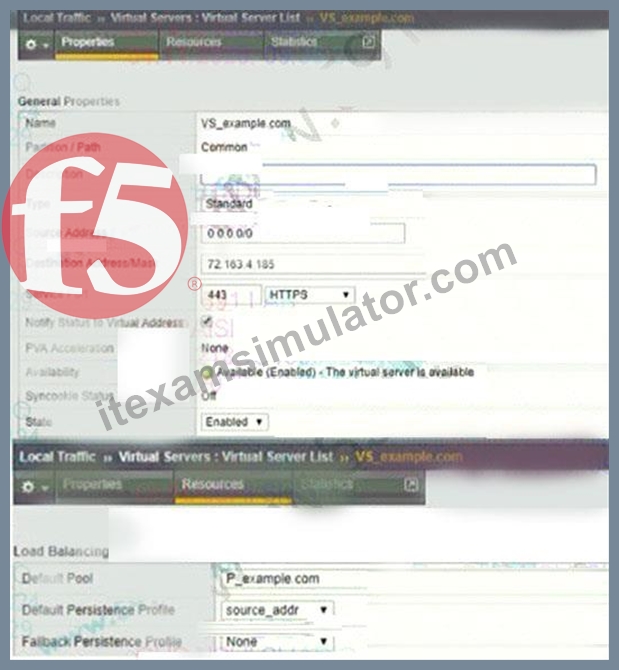
An organization is reporting slow performance accessing their Intranet website, hosted in a public cloud. All employees use a single Proxy Server with the public IP of 104.219.110.168 to connect to the Internet. What should the BIG-IP Administrator of the Intranet website do to fix this issue?
- A. Change Fallback Persistence Profile to source_addr
- B. Change Default Persistence Profile to cookie
- C. Change Source Address to 104.219.110.168/32
- D. Change Load Balancing Method to Least Connection
Answer: B
NEW QUESTION # 159
Which statement is true about the synchronization process, as performed by the Configuration Utility or by typing b config sync all.
- A. Multiple files,
including
/config/bigip.conf and
/config/bigip_base.conf,
are synchronized (made identical) each time the process is run. - B. The process should always be run from the standby system.
- C. The process should always be run from the system with the latest configuration.
- D. The two /config/bigip.conf configuration files are synchronized (made identical) each time the process is run.
Answer: D
NEW QUESTION # 160
......
201 [Sep-2025] Newly Released] Exam Questions For You To Pass: https://testking.itexamsimulator.com/201-brain-dumps.html
