

100% Pass Your NetSec-Analyst Exam Dumps at First Attempt with ITExamSimulator
Penetration testers simulate NetSec-Analyst exam PDF
Palo Alto Networks NetSec-Analyst Exam Syllabus Topics:
| Topic | Details |
|---|---|
| Topic 1 |
|
| Topic 2 |
|
| Topic 3 |
|
| Topic 4 |
|
NEW QUESTION # 24
A server-admin in the USERS-zone requires SSH-access to all possible servers in all current and future Public Cloud environments. All other required connections have already been enabled between the USERS- and the OUTSIDE-zone. What configuration-changes should the Firewall-admin make?
- A. Create a custom-service-object called SERVICE-SSH for destination-port-TCP-22. Create a security-rule between zone USERS and OUTSIDE to allow traffic from any source IP-address to any destination IP-address for SERVICE-SSH
- B. In addition to option a, a custom-service-object called SERVICE-SSH-RETURN that contains source-port-TCP-22 should be created. A second security-rule is required that allows traffic from zone OUTSIDE to USERS for SERVICE-SSH-RETURN for any source-IP-address to any destination-Ip-address
- C. Create a security-rule that allows traffic from zone USERS to OUTSIDE to allow traffic from any source IP-address to any destination IP-address for application SSH
- D. In addition to option c, an additional rule from zone OUTSIDE to USERS for application SSH from any source-IP-address to any destination-IP-address is required to allow the return-traffic from the SSH-servers to reach the server-admin
Answer: C
NEW QUESTION # 25
Selecting the option to revert firewall changes will replace what settings?
- A. dynamic update scheduler settings
- B. the running configuration with settings from the candidate configuration
- C. the candidate configuration with settings from the running configuration
- D. the device state with settings from another configuration
Answer: C
NEW QUESTION # 26
Which interface type is used to monitor traffic and cannot be used to perform traffic shaping?
- A. Layer 2
- B. Virtual Wire
- C. Layer 3
- D. Tap
Answer: D
NEW QUESTION # 27
Which URL profiling action does not generate a log entry when a user attempts to access that URL?
- A. Allow
- B. Continue
- C. Block
- D. Override
Answer: A
Explanation:
References:
NEW QUESTION # 28
A Palo Alto Networks firewall is configured for SSL Forward Proxy decryption. An internal application relies on certificate pinning for security. When users attempt to access this application, they receive certificate warnings, and the application fails to connect. The security team wants to maintain decryption for other traffic but specifically bypass decryption for this application. Which configuration change is the most precise and least impactful to the overall security posture?
- A. Import the application's specific certificate into the firewall's trusted root CA store.
- B. Modify the existing decryption profile by adding the application's FQDN to the 'SSL Decryption Exclusion' list under 'SSL Forward Proxy'.
- C. Configure a new Decryption Profile with 'Forward Untrusted Certificates' enabled and apply it only to traffic for this application.
- D. Disable 'Block Session on Untrusted Certificate' in the active decryption profile.
- E. Create a new security policy rule for the application, placing it above existing decryption rules, and set its decryption profile to 'No Decryption'.
Answer: B
Explanation:
Certificate pinning means the application expects a very specific certificate chain and will reject connections if the certificate presented by the firewall (acting as an intermediary during decryption) doesn't match. The most precise and least impactful solution is to use the 'SSL Decryption Exclusion' list. This allows the firewall to identify traffic to that specific FQDN and automatically bypass decryption for it, leaving other traffic unaffected. Option A works but is less granular, requiring a separate rule. Option C is incorrect; importing the application's end-entity certificate won't help with pinning. Option D compromises security globally. Option E also won't solve certificate pinning issues as it still involves the firewall generating a certificate, which the pinned application will reject.
NEW QUESTION # 29
Consider an advanced SD-WAN deployment using Panorama managing multiple regional hubs and spokes. The design requires that certain high-volume data replication traffic (App-Rep) originating from a spoke must always use the regional hub's primary MPLS path if available. However, if the MPLS path experiences any degradation (even minor), the traffic must immediately switch to a dedicated high-bandwidth IPsec tunnel over the internet, and remain on the IPsec tunnel until the MPLS path is fully restored and stable for a prolonged period (e.g., 5 minutes) to avoid flapping. All other traffic should use standard 'Best Quality' path selection. Which SD-WAN features and their specific configurations are essential to achieve the 'sticky failover' for App-Rep?
- A. For App-Rep, use an SD-WAN policy rule with 'Active/Backup' path selection, setting the MPLS link as 'Active' and the IPsec tunnel as 'Backup'. To prevent flapping, disable 'Automatic Failback' for this specific rule, and rely on manual intervention or a separate script to re-enable MPLS when stable.
- B. For App-Rep, create an SD-WAN policy rule with 'Performance-Based' path selection. Associate it with a 'Path Quality' profile defining strict SLA thresholds for MPLS. Crucially, configure the 'Failback Timer' within the SD-WAN profile or the specific rule to a value like 300 seconds (5 minutes) to achieve stickiness.
- C. The SD-WAN policy rule for App-Rep should use 'Performance-Based' path selection. The key is to define a 'Path Quality' profile for the MPLS link with precise 'Good' and 'Bad' thresholds. The 'Failback Timer' (or 'Revert Timer') within the SD-WAN profile's 'Advanced Settings' is the mechanism to control the stickiness, ensuring MPLS only becomes active again after prolonged stability.
- D. For App-Rep, define an SD-WAN policy rule with 'Best Quality' path selection. In the associated 'Path Quality' profile for MPLS, set very tight 'Good' thresholds. To enforce stickiness, utilize an 'Application Override' policy to force App-Rep to the IPsec tunnel after the initial failover, and manually remove it when MPLS is stable.
- E. Implement an SD-WAN policy rule for App-Rep using 'Performance-Based' path selection and a 'Path Quality' profile. Configure the 'Path Monitoring' profile for the MPLS link with aggressive probes and a higher 'Consecutive Failures' threshold to quickly detect degradation, and a 'Recovery Wait Time' for the stickiness.
Answer: B,C
Explanation:
Both A and E correctly identify the 'Failback Timer' (also known as 'Revert Timer' in some contexts) as the primary mechanism for achieving the desired 'sticky failover'. When 'Performance-Based' path selection is used with an 'active-backup' or 'preferred-path' setup, the firewall automatically reverts to the preferred path once its quality recovers to 'Good'. The 'Failback Timer' delays this reversion for the specified duration, preventing flapping. This timer is typically configured within the SD-WAN profile's advanced settings and applies to all performance- based rules using that profile or can sometimes be configured per rule depending on the PAN-OS version. Option B disables failback entirely, which is not what's desired (it should fail back eventually). Option C's 'Recovery Wait Time' is related to the path monitoring probes, not the high- level policy failback. Option D suggests Application Override, which is a manual workaround, not an integrated SD-WAN feature for dynamic failover with stickiness.
NEW QUESTION # 30
An address object of type IP Wildcard Mask can be referenced in which part of the configuration?
- A. NAT address pool
- B. ACC global filter
- C. external dynamic list
- D. Security policy rule
Answer: D
Explanation:
You can use an address object of type IP Wildcard Mask only in a Security policy rule.
https://docs.paloaltonetworks.com/pan-os/9-0/pan-os-web-interface-help/objects/objects-addresses IP Wildcard Mask
-Enter an IP wildcard address in the format of an IPv4 address followed by a slash and a mask (which must begin with a zero); for example, 10.182.1.1/0.127.248.0. In the wildcard mask, a zero (0) bit indicates that the bit being compared must match the bit in the IP address that is covered by the 0. A one (1) bit in the mask is a wildcard bit, meaning the bit being compared need not match the bit in the IP address that is covered by the 1. Convert the IP address and the wildcard mask to binary. To illustrate the matching: on binary snippet 0011, a wildcard mask of 1010 results in four matches (0001, 0011, 1001, and 1011).
NEW QUESTION # 31
A company wants to implement a 'kill switch' for critical applications. In case of a severe security incident, they need to instantly block all outbound traffic to a specific set of critical external services. The list of these services might change rapidly. How can External Dynamic Lists be leveraged for the most agile response in this scenario?
- A. Pre-configure an EDL containing a single, dummy IP address. During an incident, update the EDL source file on an internal web server with the actual critical service IPs/URLs, and the firewall will fetch the changes.
- B. Create an EDL with all critical service IPs and URLs, set its update frequency to 'Every Minute', and configure a security policy with a deny rule.
- C. Integrate with a SOAR platform that can directly push policy updates to the firewall to block the services.
- D. Use a script to dynamically update a custom URL category, which is then blocked by a URL filtering profile.
- E. Maintain a local file on the firewall with the list of critical services and manually update it during an incident.
Answer: A
Explanation:
Option D offers the most agile response using EDLs. By pre-configuring the EDL, the firewall is already set up to pull updates. The 'kill switch' is activated by modifying the source file on the internal web server. The firewall will then fetch these changes based on its configured refresh interval (which should be short). Option A is good but 'Every Minute' might still be too slow for an 'instant' kill switch and assumes the list is always complete. Option B is manual and not agile. Option C uses URL categories, which are distinct from EDLs, and the dynamic update mechanism needs to be robust. Option E is a valid approach but goes beyond just leveraging EDLs for agile response; it involves a more complex SOAR integration.
NEW QUESTION # 32
Refer to the exhibit.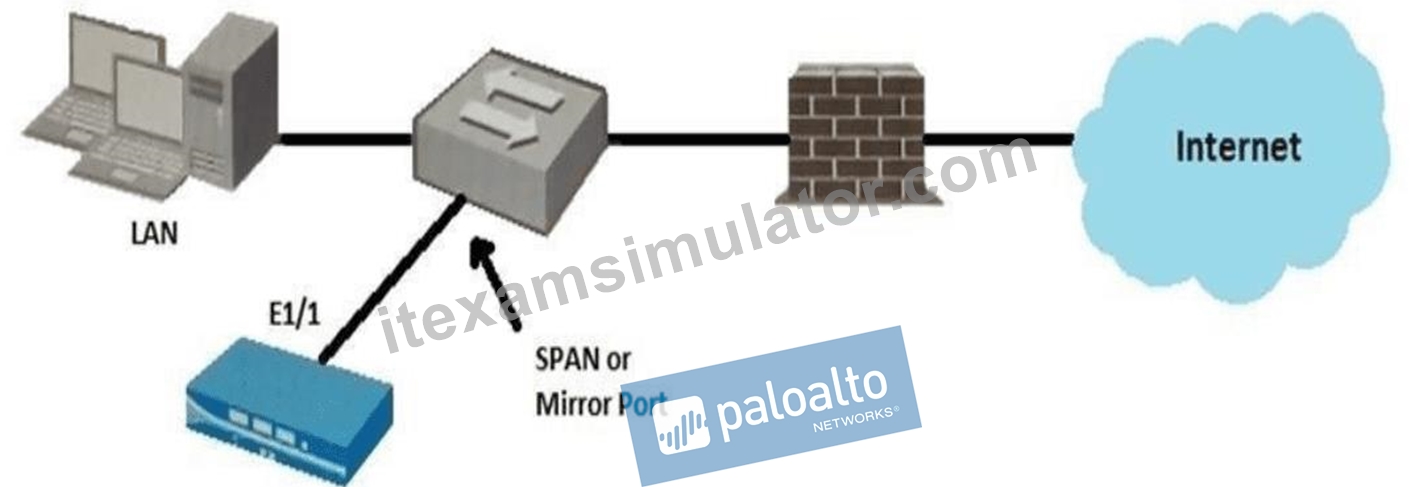
Given the topology, which zone type should you configure for firewall interface E1/1?
- A. Virtual Wire
- B. Layer3
- C. Tap
- D. Tunnel
Answer: C
NEW QUESTION # 33
The CFO found a malware infected USB drive in the parking lot, which when inserted infected their corporate laptop the malware contacted a known command-and-control server which exfiltrating corporate data.
Which Security profile feature could have been used to prevent the communications with the command-and-control server?
- A. Create a Data Filtering Profile and enable its DNS sinkhole feature.
- B. Create an Anti-Spyware Profile and enable its DNS sinkhole feature.
- C. Create a URL Filtering Profile and block the DNS sinkhole URL category.
- D. Create an Antivirus Profile and enable its DNS sinkhole feature.
Answer: B
NEW QUESTION # 34
A large-scale deployment uses Panorama to manage hundreds of Palo Alto Networks firewalls. An External Dynamic List (EDL) for 'IP Address' type is centrally configured on Panorama, pointing to an internal threat intelligence server. Which of the following statements accurately describes the operational flow and considerations when this EDL is applied to Security Policy rules pushed from Panorama to the managed firewalls?
- A. EDLs configured on Panorama can only be used in Pre-Rulebase or Post-Rulebase policies, not in shared rulebases.
- B. Only firewalls with Panorama's 'Threat Prevention' subscription can utilize EDLs configured on Panorama.
- C. Panorama fetches the EDL content and pushes the entire list to each firewall during a policy commit.
- D. If the threat intelligence server is unreachable, Panorama will cache the last known good list and push it to all firewalls.
- E. Each managed firewall independently fetches the EDL content directly from the threat intelligence server based on its configured refresh interval, and Panorama only distributes the EDL object definition.
Answer: E
Explanation:
This question tests the understanding of how Panorama manages dynamic content. Option B (Correct): Panorama manages the definition of the EDL (its name, type, source URL, refresh interval, etc.) and pushes this definition to managed firewalls. However, each individual firewall is responsible for fetching the actual content of the EDL directly from the configured source URL. This design distributes the load and ensures firewalls have the most up-to-date lists even if Panorama is temporarily unavailable. Option A is incorrect; Panorama does not typically fetch and push the content of EDLs. Option C is incorrect; EDL functionality is core and not tied to specific subscriptions like Threat Prevention. Option D is incorrect; EDLs can be used in any rulebase (shared, device-group, template). Option E is incorrect; Panorama does not cache EDL content for pushing to firewalls if the source is unreachable; the individual firewalls attempt to fetch and will log errors if they fail.
NEW QUESTION # 35
Which action results in the firewall blocking network traffic without notifying the sender?
- A. Reset Client
- B. Deny
- C. Drop
- D. No notification
Answer: C
NEW QUESTION # 36
A critical infrastructure organization is upgrading its SCADA network and has deployed Palo Alto Networks NGFWs to secure the environment. They need to implement an IoT security profile that strictly adheres to the Purdue Model for segmentation and communication. Specifically, they want to:
1. Allow only specific Modbus/TCP function codes (Read Coils, Read Holding Registers) between Zone 3 (Control Servers) and Zone 2 (PLCs).
2. Block all internet access for devices in Zone 2 and Zone 3.
3. Alert on any new, unclassified device attempting to communicate within Zone 2 or Zone 3.
4. Implement signature-based protection against known ICS exploits.
Which of the following configuration steps, in combination, are necessary to achieve these requirements using a Palo Alto Networks IoT Security Profile and related features? (Multiple Response)
- A. Create an 'IoT Security Profile' for ICS, enabling 'Application Function Filtering' for Modbus/TCP to permit only 'Read Coils' and 'Read Holding Registers'. Apply this profile to an 'IoT Policy Rule' between Zone 3 and Zone 2, with 'Application' set to 'modbus-tcp'.
- B. Configure a 'Vulnerability Protection' profile with a focus on 'Critical' and 'High' severity signatures, especially those related to SCADA/ICS vulnerabilities, and apply it to all relevant security policies.
- C. Create a custom 'Anti-Spyware' profile with specific Modbus/TCP signatures and apply it to all security rules for Zone 2 and Zone 3 traffic.
- D. Configure 'Security Policies' with 'Source Zone: Zone 2/3', 'Destination Zone: Untrust', 'Application: any', 'Service: any', and 'Action: Deny'. Ensure these rules are placed higher than any default permit rules.
- E. Utilize 'Device-ID' within the IoT Security Profile to automatically identify and classify devices in Zone 2 and Zone 3. Configure 'IoT Policy Rules' to use 'IoT Device Groups' as source/destination and set 'Action: Alert' for unknown device communication attempts.
Answer: A,B,D,E
Explanation:
This question requires a comprehensive understanding of Palo Alto Networks' IoT security features.
A: Correct. 'Application Function Filtering' is precisely for granular control over industrial protocols like Modbus/TCP functions.
B: Correct. Explicit deny rules are essential for blocking unwanted internet access, especially for critical infrastructure, and their placement in the rulebase is crucial.
C: Correct. Device-ID and IoT Device Groups are fundamental for dynamic classification and alerting on rogue devices. This fulfills requirement #3.
D: Incorrect. 'Anti-Spyware' is primarily for C2 and malware. 'Vulnerability Protection' (E) is the correct profile for signature-based ICS exploit protection.
E: Correct. 'Vulnerability Protection' profiles are designed for blocking known exploits and vulnerabilities, including those specific to ICS, fulfilling requirement
NEW QUESTION # 37
View the diagram.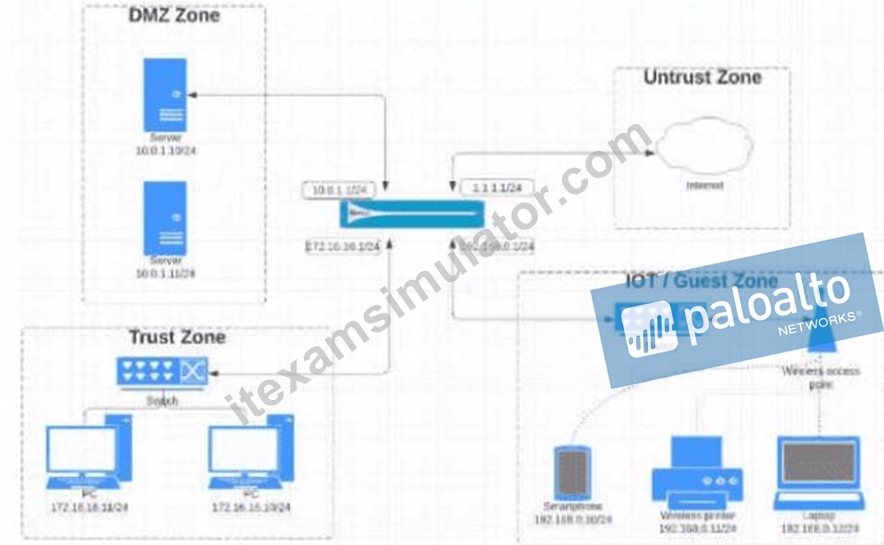
What is the most restrictive yet fully functional rule to allow general Internet and SSH traffic into both the DMZ and Untrust/lnternet zones from each of the lOT/Guest and Trust Zones?
- A.

- B.

- C.

- D.

Answer: B
NEW QUESTION # 38
Refer to the exhibit. A web server in the DMZ is being mapped to a public address through DNAT.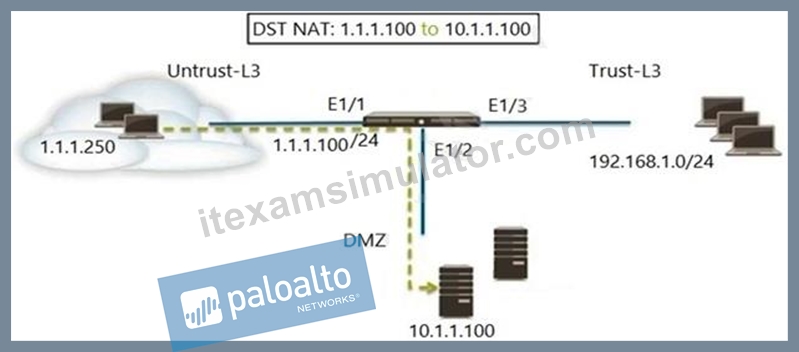
Which Security policy rule will allow traffic to flow to the web server?
- A. Untrust (any) to Untrust (10.1.1.100), web browsing -Allow
- B. Untrust (any) to Untrust (1.1.1.100), web browsing - Allow
- C. Untrust (any) to DMZ (1.1.1.100), web browsing - Allow
- D. Untrust (any) to DMZ (10.1.1.100), web browsing -Allow
Answer: C
NEW QUESTION # 39
Given the scenario, which two statements are correct regarding multiple static default routes? (Choose two.)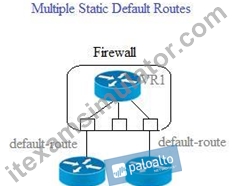
- A. Path monitoring determines if route is useable
- B. Route with lowest metric is actively used
- C. Path monitoring does not determine if route is useable
- D. Route with highest metric is actively used
Answer: A,B
NEW QUESTION # 40
Which user mapping method could be used to discover user IDs in an environment with multiple Windows domain controllers?
- A. domain controller monitoring
- B. Active Directory monitoring
- C. Windows client probing
- D. Windows session monitoring
Answer: B
NEW QUESTION # 41
A large enterprise is migrating its globally distributed Palo Alto Networks firewalls to Strata Cloud Manager (SCM). They have a complex security policy hierarchy with granular administrative access requirements. Which SCM feature is crucial for managing this complexity while adhering to a least-privilege model for their security operations team, especially when integrating with existing identity providers?
- A. Role-Based Access Control (RBAC) with SAML/RADIUS integration
- B. SD-WAN Orchestration
- C. Application-ID Policy Enforcement
- D. Zero Touch Provisioning (ZTP)
- E. Cloud-Delivered Security Services (CDSS) subscription management
Answer: A
Explanation:
Role-Based Access Control (RBAC) in SCM allows administrators to define precise permissions for different roles (e.g., 'Policy Administrator', 'Monitor Analyst'). Integrating with existing identity providers like SAML or RADIUS ensures that user authentication and authorization are centralized and consistent with enterprise security policies, upholding the least-privilege principle. This is critical for managing complex security policy hierarchies and distributed teams.
NEW QUESTION # 42
The Palo Alto Networks NGFW was configured with a single virtual router named VR-1 What changes are required on VR-1 to route traffic between two interfaces on the NGFW?
- A. Add interfaces to the virtual router
- B. Enable the redistribution profile to redistribute connected routes
- C. Add zones attached to interfaces to the virtual router
- D. Add a static routes to route between the two interfaces
Answer: D
NEW QUESTION # 43
What is used to monitor Security policy applications and usage?
- A. App-ID
- B. Security profile
- C. Policy Optimizer
- D. Policy-based forwarding
Answer: C
Explanation:
https://docs.paloaltonetworks.com/pan-os/9-1/pan-os-web-interface-help/policies/policies-security
/applications-and-usage
NEW QUESTION # 44
Which System log severity level would be displayed as a result of a user password change?
- A. Medium
- B. High
- C. Low
- D. Critical
Answer: C
Explanation:
System logs display entries for each system event on the firewall.
1. Critical - Hardware failures, including high availability (HA) failover and link failures.
2. High - Serious issues, including dropped connections with external devices, such as LDAP and RADIUS servers.
3. Medium - Mid-level notifications, such as antivirus package upgrades.
4. Low - Minor severity notifications, such as user password changes.
5. Informational - Log in/log off, administrator name or password change, any configuration change, and all other events not covered by the other severity levels.
https://docs.paloaltonetworks.com/pan-os/11-0/pan-os-admin/monitoring/view-and-manage-logs/log-types-and-severity-levels/system-logs#id8edbfdae-ed92-4d8e-ab76-6a38f96e8cb1
NEW QUESTION # 45
A Palo Alto Networks firewall is forwarding logs to an external syslog server. The Security team reports that some critical 'threat' logs, particularly those with 'severity critical', are occasionally missing from the syslog server, especially during peak network activity. Upon investigation, the firewall's system logs show 'log-pkt-discard' messages, and the syslog server is reachable and responsive. What is the most probable cause for these missing logs, and what configuration change within the Log Forwarding Profile or related settings could best mitigate this issue?
- A. The firewall's management plane is overloaded, causing it to drop logs before forwarding. Increase the 'Maximum Log Queue Size' in 'Device > Setup > Management > Logging and Reporting Settings'.
- B. The 'Log Filtering' within the Log Forwarding Profile is inadvertently excluding critical threat logs. Review and correct the filter expressions to ensure critical logs are included.
- C. The syslog server's UDP buffer is overflowing. Change the Log Forwarding Profile to use TCP as the protocol for syslog, as TCP provides reliable delivery and retransmission.
- D. The 'Log Rate Limit' for syslog forwarding is too low, causing logs to be discarded once the rate is exceeded. Increase the 'Log Rate Limit' in 'Device > Setup > Management > Logging and Reporting Settings'.
- E. The Log Forwarding Profile is configured with a 'Commit Threshold' that is too high, leading to logs being buffered and potentially dropped during high volume. Lower the commit threshold.
Answer: C
Explanation:
The presence of 'log-pkt-discard' messages on the firewall when the syslog server is responsive, coupled with critical logs going missing, strongly suggests that UDP packets are being dropped, either by the firewall itself due to internal resource constraints during transmission (less likely if the issue is intermittent during 'peak network activity' and the server is 'responsive') or more commonly, by an overloaded UDP listener on the syslog server or an intermediary network device. UDP is a connectionless protocol without guaranteed delivery. Switching to TCP (Option A) provides reliable, ordered, and acknowledged delivery, mitigating packet loss due to transient network congestion or receiver overflow, which aligns with 'log-pkt-discard' and missing logs during high activity. Option B (queue size) helps with bursts but TCP is for reliable delivery. Option C (Commit Threshold) is related to log storage on the firewall itself for disk logging, not forwarding. Option D (Log Rate Limit) would cause discards, but simply increasing it might just shift the problem. Option E (filtering) implies consistent filtering, not intermittent loss.
NEW QUESTION # 46
During the App-ID update process, what should you click on to confirm whether an existing policy rule is affected by an App-ID update?
- A. test policy match
- B. review policies
- C. check now
- D. download
Answer: B
NEW QUESTION # 47
A Security Administrator is configuring a Palo Alto Networks firewall to block access to known malicious IP addresses. The threat intelligence feed updates hourly and contains thousands of entries. Which External Dynamic List (EDL) type is most appropriate for this scenario to ensure the firewall efficiently processes and applies the updates?
- A. Pre-defined EDL (e.g., Palo Alto Networks' Threat Prevention feeds)
- B. URL
- C. IP Address (IPv4/lPv6)
- D. Domain
- E. Custom Application
Answer: C
Explanation:
For blocking known malicious IP addresses, an 'IP Address (IPv4/lPv6)' EDL is the most direct and efficient type. While Palo Alto Networks' pre-defined feeds are also IP-based and often used, the question specifically asks for the most appropriate type when the administrator is configuring a feed with thousands of entries, implying a custom or third-party feed. Domain and URL lists are for FQDNs and URLs, respectively, not raw IP addresses. Custom Application is irrelevant here.
NEW QUESTION # 48
......
All NetSec-Analyst Dumps and Training Courses: https://testking.itexamsimulator.com/NetSec-Analyst-brain-dumps.html
